
The Sublime, Revisited
Terror, Beauty, and the Work of Hope

Growing up as the daughter of an English professor, there were many moments when I “hung out” with other professors—gracious colleagues who babysat while my dad taught or attended lectures. During that time, I was introduced to William Wordsworth, a Romantic poet who, unknowingly, for a child of three, embodied the Sublime perfectly. Two poems that at one time I could recite by heart:
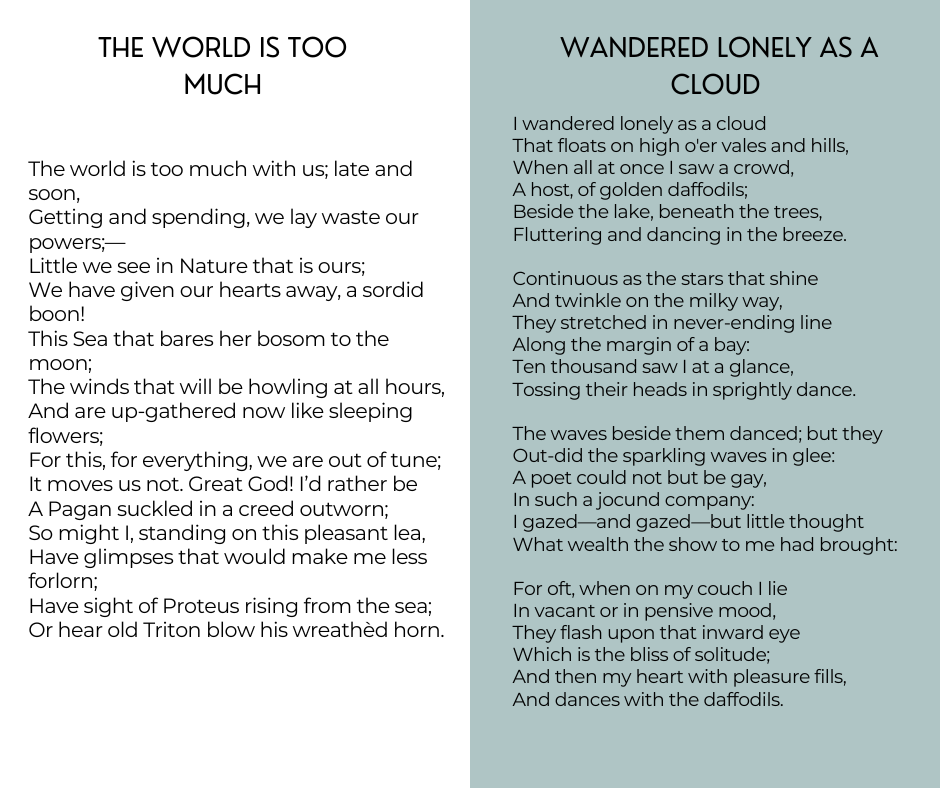
I did not yet know how often I would return to these ideas throughout my life.
The First Time I Taught the Sublime
In 2009, I taught the Sublime for the first time.
I remember lingering on Edmund Burke’s words with my students:
“No passion so effectually robs the mind of all its powers of acting and reasoning as terror; and whatever is terrible with regard to sight, is sublime.”
At the time, we were trying to understand the impact of the industrial age in the eighteenth-century. We were naming the way awe and fear can live in the same breath. We were, in the abstract way classrooms sometimes allow, trying to understand how unspeakable beauty and true terror coexist.
I certainly did not know how much the arts would become my roadmap for hope.
Not Escape. Instruction.
The last few months have felt, in many ways, sublime in the Burkean sense—overwhelming, disorienting, at times terrifying in their scope and speed. And yet, again and again, I have found myself returning to the arts not as escape, but as instruction.
Not as distraction. As direction.
Because the arts do something schools and systems often struggle to do: they hold complexity without rushing to resolve it.
They let us (me) feel first.
They let us (me) imagine forward.
The Power of Being Seen
I have visited Amy Sherald’s American Sublime twice now, and I am still not sure it will ever be enough.
The first time, I felt something immediate and visceral: seen, represented, and—paradoxically—made beautifully small in the presence of so many expansive depictions of Black life.
Sherald describes the exhibition as “a salve… a call to remember our shared humanity and an insistence on being seen.”
That language has stayed with me because it so precisely names the work I believe schools must do. The work that has made it known why I belong in schools.
To be seen is not a soft aspiration.
It is structural.
It is pedagogical.
It is, I would argue, foundational to belonging.


Full-Circle Moments
The arts keep giving me these quiet full-circle moments.
A few days ago, I sat in the Met Opera House watching The Amazing Adventures of Kavalier & Clay, knowing that one of the performers lighting up the stage was Sun-Ly Pierce—once a child I babysat, now commanding one of the most storied stages in the world.
The message of the show—about imagination, escape, identity, and reinvention—felt almost too on the nose for this moment in time.
The opera adaptation—music by Mason Bates, libretto by Gene Scheer—translates Michael Chabon’s sweeping novel into something immediate and embodied, where imagination and longing are felt as much as understood.


And in January, there was the unexpected full-circle moment of meeting Lin-Manuel Miranda at the Hamilcast wrap party—a reminder of how one artistic work can ripple outward into classrooms, podcasts, electives, and entirely new lines of inquiry.


What began for me as revising a lesson, turned into a Hamilton-inspired elective and evolved into something much larger: a course examining representation across race, gender, sexuality, and identity on stage and screen.
Because once students start seeing patterns, they cannot unsee them.
I am nothing if not a consummate student.
And that is the quiet power of the arts in education.
Meeting Students Where They Already Are
In November 2025, Heated Rivalry premiered on CRAVE/HBO. Like many works that center queer love stories in sports spaces, it opened conversations far beyond its immediate audience.
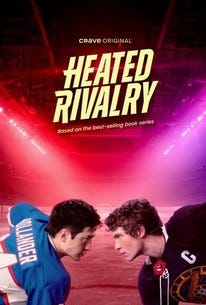
I found myself doing what educators do when something culturally resonant appears:
I built curriculum.
Not because television needs school validation.
But because students are already watching.
Already wondering.
Already forming ideas about love, sports culture, masculinity, belonging, and whose stories get centered — informed not only by scripted narratives, but by the very real behaviors they see modeled by athletes and teams in the public eye.
Under Jacob Tierney’s direction, Heated Rivalry resists the easy tropes of sports storytelling and instead leans into something more human—offering young people a narrative landscape that is far more emotionally and culturally complex than many of the sports stories they have historically been given.
The question is whether the adults in their lives, their parents—and schools—will willingly meet them there.
The World We Are Trying to Build
What keeps returning to me—from Burke to Sherald to Chabon to Miranda to Tierney to the students themselves—is this:
The arts do not just reflect the world.
They rehearse the world.
They prototype belonging.
They give us emotional blueprints for futures we have not yet fully built.
And if independent schools truly aspire to prepare students not just for college, but for citizenship—for humanity, for ethical participation in a diverse, pluralistic world—then we cannot treat the arts as enrichment.
They are infrastructure.
Looking Forward
My hope—in my work with students, families, and faculty—is to keep widening the circle of who feels seen, who feels invited, and who feels equipped to participate in the ongoing project of building more inclusive communities.
Because what the world needs now is not less dialogue.
It needs braver dialogue.
More generous dialogue.
More imaginatively informed dialogue.
The arts , when we let them, show us how.
Dedication
For Laurie — the best godmother I could have ever asked for — who, among the many beautiful things she did while on this earth, gave me one of the greatest gifts of my life: a lifelong friend in her eldest, Angela Grace, who shows me every day what it means to live in a way that helps others feel truly seen, loved and deeply cared for.
Yom, what a beautiful piece. Thank you for inviting us in and modeling what is possible.